Truncation by death

One-step Outcome Imputation: An Alternative to Multiple Imputation

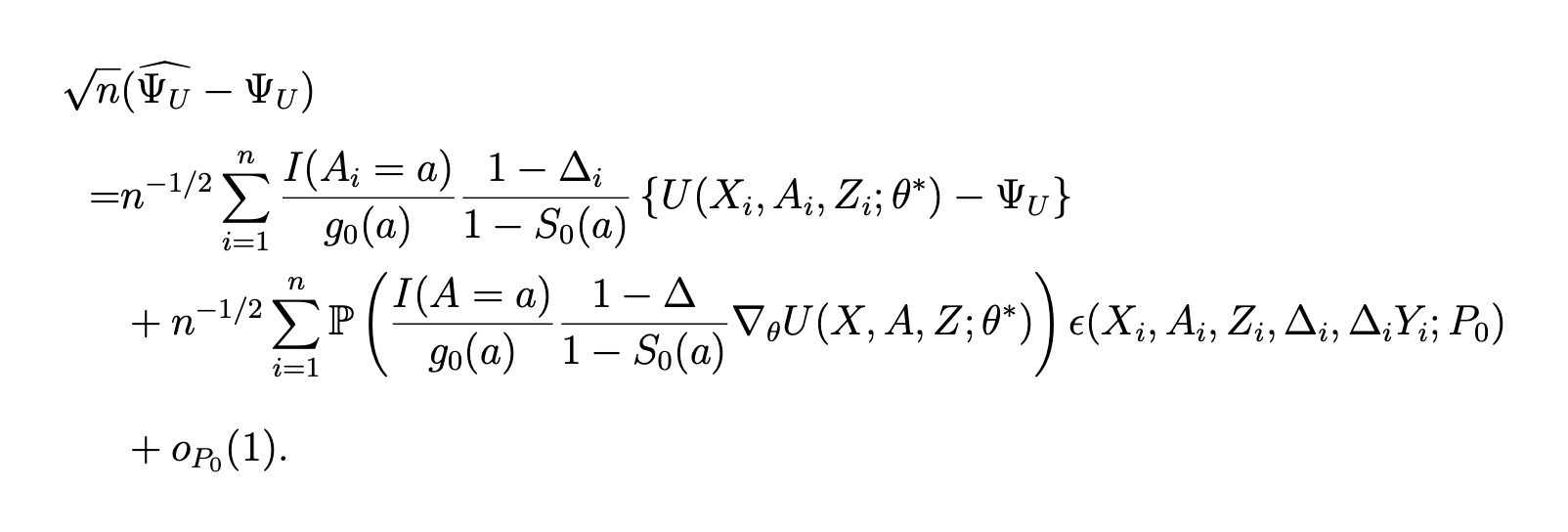
Missing outcomes in randomized controlled trials are often handled by multiple imputation (MI). Rubin’s rules are routinely used to estimate standard errors but can fail to provide valid standard error estimates for some commonly used procedures, such as reference-based imputation. We propose a one-step alternative by explicitly targeting the treatment effect implied by a given imputation model and constructing an efficient one-step estimator for that treatment effect via its influence function. Unlike Rubin’s rules, this approach yields asymptotically valid inference. Moreover, the proposed method circumvents the stochastic component and computational burden of MI. We illustrate the approach with examples spanning a range of imputation models, including reference-based imputation and intercurrent-event-dependent imputation. The one-step imputation estimation procedure is implemented in the targeted R package.
September 2026 · Andreas Nordland, Klaus Kähler Holst, David Redek, Christian Bressen Pipper, Aske Thorn Iversen
Cox regression with missing covariates

Cox regression with missing covariate data using a modified partial likelihood method

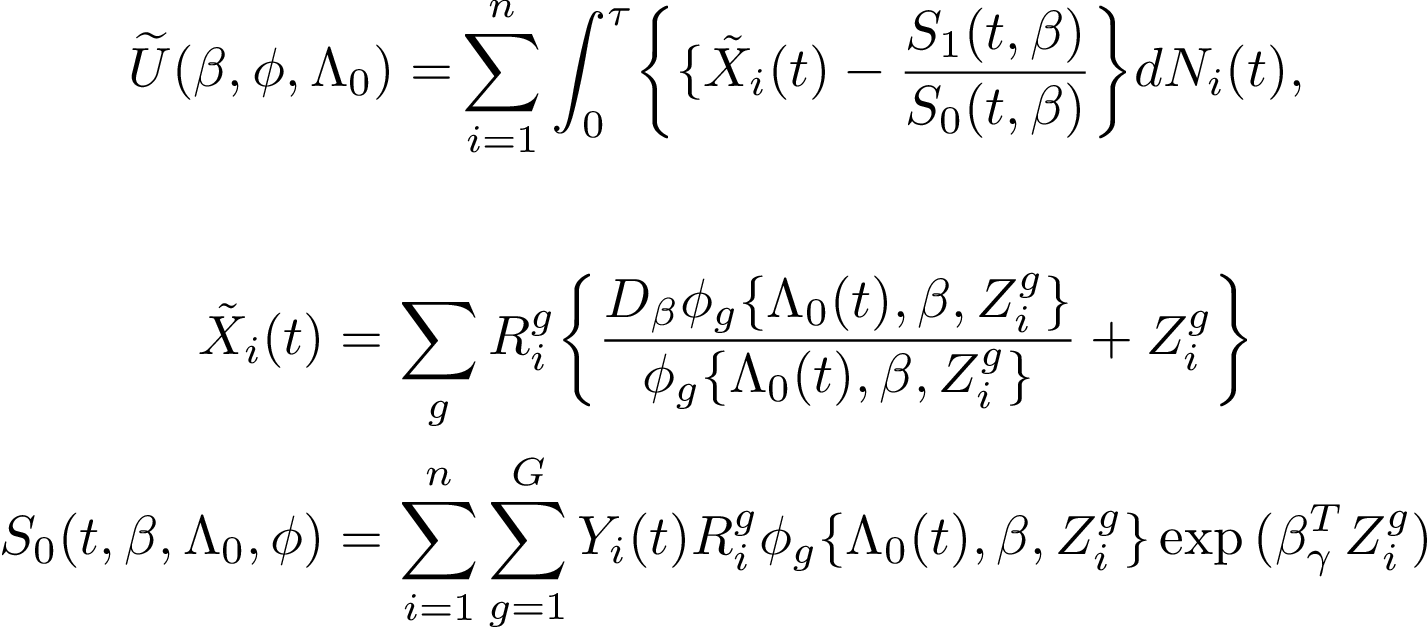
Missing covariate values is a common problem in survival analysis. In this paper we propose a novel method for the Cox regression model that is close to maximum likelihood but avoids the use of the EM-algorithm. It exploits that the observed hazard function is multiplicative in the baseline hazard function with the idea being to profile out this function before carrying out the estimation of the parameter of interest. In this step one uses a Breslow type estimator to estimate the cumulative baseline hazard function. We focus on the situation where the observed covariates are categorical which allows us to calculate estimators without having to assume anything about the distribution of the covariates. We show that the proposed estimator is consistent and asymptotically normal, and derive a consistent estimator of the variance–covariance matrix that does not involve any choice of a perturbation parameter. Moderate sample size performance of the estimators is investigated via simulation and by application to a real data example.

January 2017 · Torben Martinussen, Klaus Kähler Holst, Thomas H. Scheike