simplex

A Joint QoL–Survival Framework with Debiased Estimation under Truncation by Death

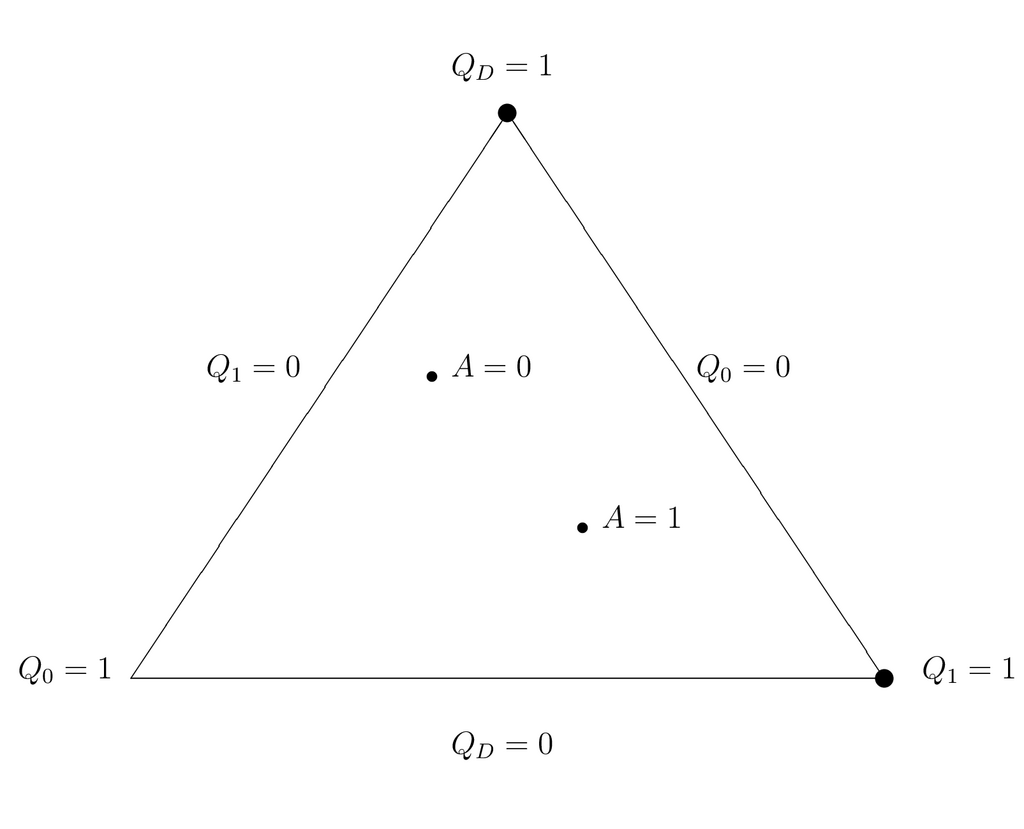
Evaluating quality-of-life (QoL) outcomes in populations with high mortality risk is complicated by truncation by death, since QoL is undefined for individuals who do not survive to the planned measurement time. We propose a framework that jointly models the distribution of QoL and survival without extrapolating QoL beyond death. Inspired by multistate formula tions, we extend the joint characterization of binary health states and mortality to continuous QoL outcomes. Because treatment effects cannot be meaningfully summarized in a single one dimensional estimand without strong assumptions, our approach simultaneously considers both survival and the joint distribution of QoL and survival with the latter conveniently displayed in a simplex. We develop assumption-lean, semiparametric estimators based on efficient influence functions, yielding flexible, root-n consistent estimators that accommodate machine-learning methods while making transparent the conditions these must satisfy. The proposed method is illustrated through simulation studies and two real-data applications.
February 2026 · Torben Martinussen, Klaus Kähler Holst, Christian Bressen Pipper, Per Kragh Andersen
intersection testing

A general approach to construct powerful tests for intersections of one-sided null-hypotheses based on influence functions

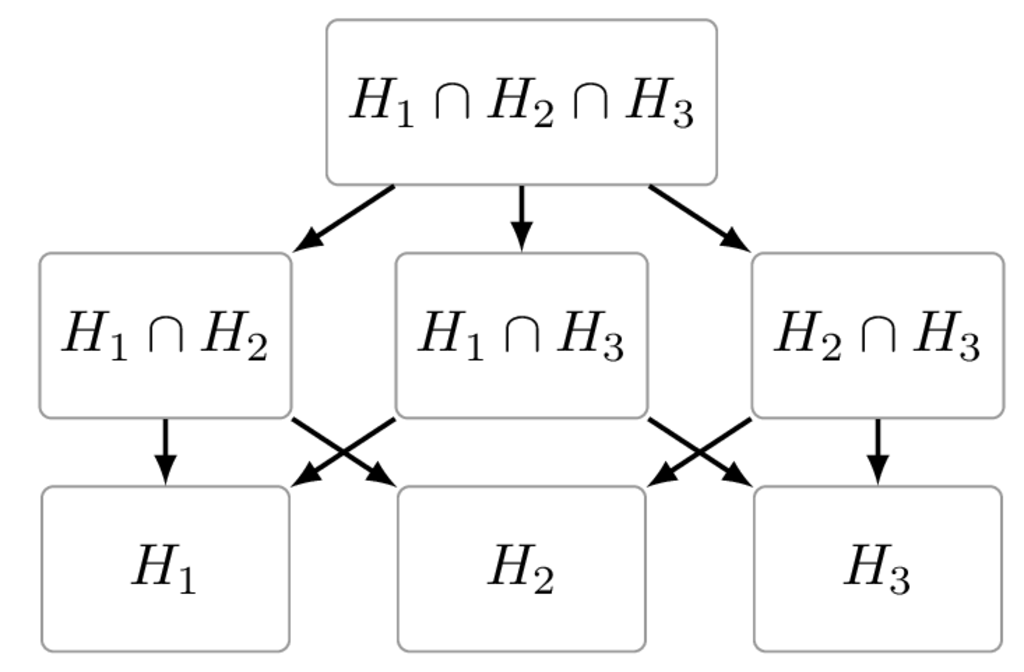
Testing intersections of null-hypotheses is an integral part of closed testing procedures for assessing multiple null-hypotheses under family-wise type 1 error control. Popular intersection tests such as the minimum p-value test are based on marginal p-values and are typically evaluated conservatively by disregarding simultaneous behavior of the marginal p-values. We consider a general purpose Wald type test for testing intersections of one-sided null-hypotheses. The test is constructed on the basis of the simultaneous asymptotic behavior of the p values. The simultaneous asymptotic behavior is derived via influence functions of estimators using the so-called stacking approach. In particular, this approach does not require added assumptions on simultaneous behavior to be valid. The resulting test is shown to have attractive power properties and thus forms the basis of a powerful closed testing procedure for testing multiple one-sided hypotheses under family-wise type 1 error control.

November 2025 · Christian Bressen Pipper, Andreas Nordland, Klaus Kähler Holst